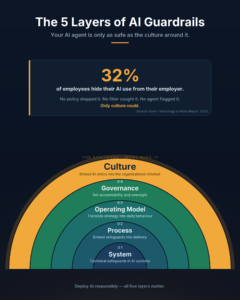

Most organizations have built four layers of protection for their AI agents. Without the fifth, all four can quietly fail.
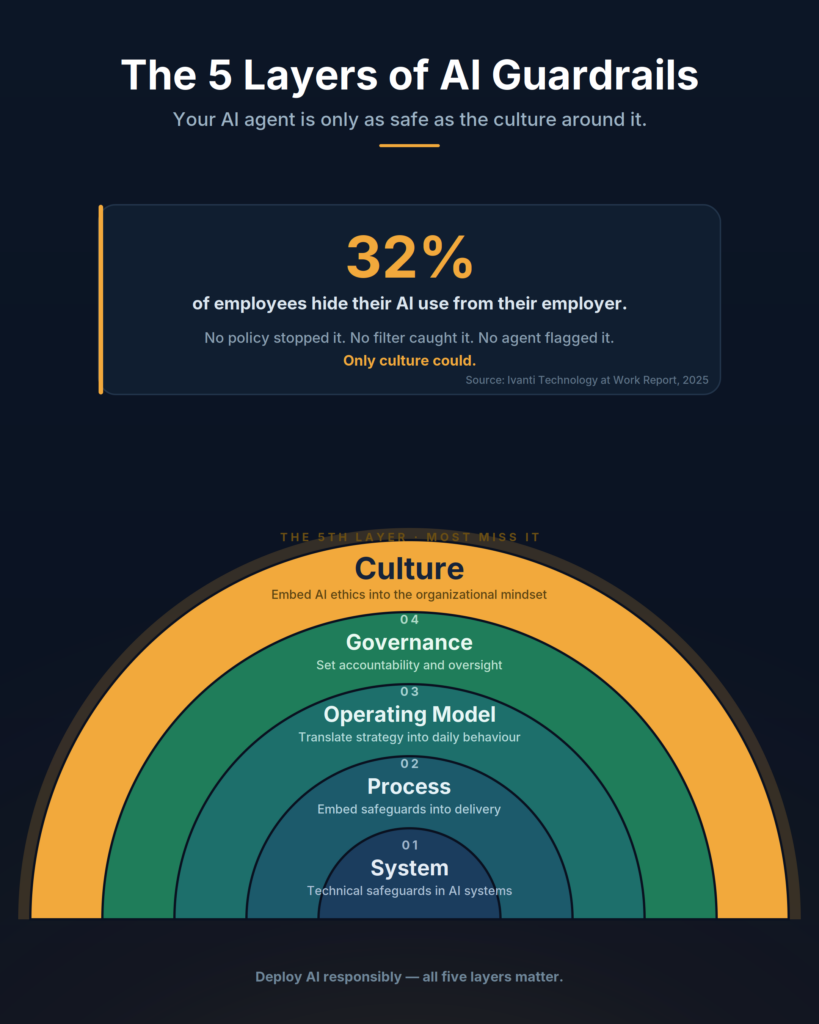
If you’ve spent any time thinking about deploying AI responsibly, you’ve probably encountered some version of the AI guardrails stack. It usually looks like four layers, working from the technical core outward:
- System — the technical safeguards: prompt guardrails, content filters, output validation, PII detection.
- Process — the human checkpoints: review steps, approval paths, escalation workflows, shadow-AI management.
- Operating Model — the translation of strategy into daily behavior: usage policies, staff training, responsible-use standards.
- Governance — the oversight that sits above it all: risk frameworks, an AI ethics committee, an accountability model, compliance reviews.
It’s a solid framework. Every organization shipping AI into production needs all four layers, and most of the engineering conversation rightly focuses on the System layer because that’s where the measurable controls live.
But there’s a fifth layer that sits above all of them — and when it’s missing, the other four don’t fail loudly. They erode. Slowly, quietly, and in ways your dashboards won’t catch.
That fifth layer is Culture.
The four layers are necessary. They’re just not self-sustaining.
Here’s the uncomfortable truth about technical guardrails: every one of them depends on a human deciding to use it as intended.
A content filter blocks a harmful prompt — but only if someone routes the request through the filtered endpoint instead of pasting it into a personal ChatGPT tab. An approval workflow catches a risky deployment — but only if the engineer files the request instead of shipping around it. An output-validation step flags a hallucination — but only if the reviewer actually reads the flag instead of rubber-stamping the output to hit a deadline.
Each layer assumes good-faith participation from the people operating it. Governance writes the rules. Process enforces them at checkpoints. The Operating Model trains people on them. But none of those layers can manufacture the one thing they all quietly rely on: people who want to use AI well, even when no one is watching.
That want is culture. And it’s the part nobody can install with a config change.
What “culture as a guardrail” actually means
Culture is the layer people most often wave away as soft, unmeasurable, or a problem for HR. That’s a mistake. In the context of AI safety, culture is a concrete and observable set of behaviors:
- AI literacy at every level, not just on the engineering team. People who understand what a model can and can’t do are far less likely to over-trust an output or hide a mistake.
- Psychological safety to question or push back on AI output. The single most valuable safety behavior in an organization is an employee who feels free to say “this doesn’t look right” without fear of looking slow or incompetent.
- Leadership visibly modeling responsible AI use. If executives quietly paste confidential data into unapproved tools, no policy document will outweigh that signal.
- Transparency over AI use — no hiding, no fear, no “secret advantage” economy.
- Ethical instinct built into everyday decisions, so that the right call gets made in the thousands of moments that never reach a formal review.
This is the difference between an employee who flags a hallucinating agent and one who quietly submits its output because pushing back feels riskier than staying silent. The first behavior is a safety control. The second is an incident waiting to surface.
The statistic that should end the debate
If you’re not convinced culture belongs in the guardrails stack, consider this.
According to Ivanti’s 2025 Technology at Work Report — a survey of more than 6,000 office employees — nearly a third of workers keep their use of AI a secret from their employer, even as overall reported AI use at work jumped to 42% in 2025 from 26% the year before. The reasons aren’t technical at all. Roughly a third like having a secret advantage, around a quarter cite imposter syndrome and not wanting their abilities questioned, and a comparable share worry their AI-driven productivity will simply earn them more work or put their job at risk.
Sit with what that means for your guardrails stack.
No governance policy stopped that hiding. No content filter caught it. No approval workflow flagged it. No agent raised an alert. By definition, every one of your four technical layers was bypassed — not through a clever exploit, but because people had a cultural incentive to route around them.
This is the failure mode that the System, Process, Operating Model, and Governance layers cannot see, because the activity never enters the systems those layers protect. Shadow AI isn’t primarily an access-control problem. It’s a trust problem wearing an access-control costume. And only culture operates in the space where it actually lives.
Why this gets more dangerous, not less, as agents mature
Early AI deployments were mostly assistive: a human prompted a model, read the result, and decided what to do with it. The human was the integration point, which meant the human’s judgment was a natural backstop.
Agentic systems collapse that backstop. As agents take multi-step actions, call tools, write to systems, and chain decisions together with less human intervention per action, the number of moments where a person could catch a problem drops sharply. The technical layers get more important — and simultaneously, the human layer gets thinner and more decisive. When a person does enter the loop, their willingness to stop, question, and escalate becomes the last meaningful line of defense.
That willingness is not a System-layer property. You can’t ship it in a release. It’s cultural, and it compounds: teams that have practiced psychological safety and transparency around AI will keep catching things as autonomy increases. Teams that haven’t will find their human checkpoints have quietly become formalities.
How the layers actually relate
It helps to stop thinking of these as a stack of independent controls and start thinking of them as a dependency chain.
- System is only as effective as the Process that routes work through it.
- Process is only as effective as the Operating Model that gets people to follow it by default.
- The Operating Model is only as effective as the Governance that gives it authority and accountability.
- And all four are only as effective as the Culture that makes people choose to participate when the rules aren’t being enforced in that exact moment.
Governance sets the rules. Culture makes people want to follow them. Take the bottom layer away and the structure still stands. Take the top layer away and the whole thing slowly hollows out from the inside while every dashboard still shows green.
What to do before your next rollout
If you’re about to deploy or expand an AI agent, the System-layer questions are probably already on your checklist. Add the rest:
- Do we have a risk framework and a clear accountability model — someone who owns the consequences of an AI decision?
- Do we have usage policies people actually understand, and a Process that makes the safe path the easy path?
- Do we have technical guardrails — filters, validation, PII detection — on every route work can take, including the unofficial ones?
- And the question most rollouts skip: do we have a culture that makes all of the above actually work? Can someone on the team push back on a confident-sounding model output without career risk? Does leadership model the behavior it asks for? Is using AI a thing people do in the open, or a secret advantage they’re protecting?
The organizations winning with AI right now aren’t simply the ones with the best models or the tightest system controls. They’re the ones where people feel trusted, informed, and responsible enough to use AI well even when no one is watching.
Build all five layers. The first four keep your AI agent inside the lines. The fifth is what keeps the first four alive.