12 Must-Know Agentic AI Terms: The Complete Technical Guide
The AI landscape is shifting fast. Two years ago, “GenAI” was the buzzword. Today, the frontier belongs to Agentic AI — systems that don’t just respond, they reason, plan, act, and collaborate. Here’s your definitive technical breakdown of the 12 terms every developer, architect, and AI practitioner must know in 2025.
What Is Agentic AI?
Before diving in, let’s set the stage. Agentic AI refers to AI systems that operate with a degree of autonomy — they pursue goals, make decisions, use tools, and take actions in the real world without requiring a human to prompt every single step. Think less “chatbot” and more “digital co-worker.”
These systems are built on a rich vocabulary. Misunderstand the terminology, and you’ll misunderstand the architecture. Let’s fix that.
The 12 Core Agentic AI Terms
1. MCP — Model Context Protocol
Category: Open Standard / Integration Layer
MCP is an open standard that enables AI agents to connect to external tools, APIs, and data sources through a unified interface. Think of it as the USB-C of AI integrations — one standard protocol to plug into anything.
Instead of building custom connectors for every service, MCP lets agents communicate across systems in a standardized way — dramatically reducing integration complexity.
🔍 Real-World Example: Claude connects to GitHub via MCP to autonomously read and write code — no custom plugin required.
Why it matters technically:
- Eliminates per-tool API wrappers
- Enables plug-and-play agent extensibility
- Standardizes authentication, context passing, and response handling
2. Agent Loop — PERCEIVE → PLAN → ACT → OBSERVE
Category: Core Reasoning Architecture
The Agent Loop is the heartbeat of any autonomous AI system. It’s the continuous reasoning cycle that makes an agent feel alive:
- Perceive — Ingest inputs (text, files, tool results, environment state)
- Plan — Reason about what needs to be done
- Act — Execute the chosen action (call a tool, write output, etc.)
- Observe — Evaluate results and feed them back into the loop
This cycle repeats until the task is complete or the agent hits a stopping condition.
🔍 Real-World Example: An agent reads an error log, plans a code fix, runs the updated code, and checks whether the tests pass — all in one uninterrupted loop.
Why it matters technically:
- Enables multi-step task completion without human hand-holding
- The loop architecture determines latency, cost, and reliability
- Poorly designed loops can lead to infinite cycles or token waste
3. Tool Use — Agent Capabilities
Category: Agent Capabilities
Tool Use is the ability of an AI model to call external functions — APIs, code runners, web browsers, databases — to interact with the real world. Without tool use, agents are limited to what’s in their training data.
With tool use, they become dynamic. They can fetch live data, execute code, search the web, send messages, or manipulate files.
🔍 Real-World Example: An agent calls a weather API mid-conversation to accurately answer “Should I fly to NYC tomorrow?” instead of guessing from stale training data.
Why it matters technically:
- Bridges the gap between language understanding and real-world action
- Tool schemas (function signatures) must be well-defined to avoid misuse
- Tool selection logic is a major driver of agent intelligence and efficiency
4. Orchestrator — Agent Manager
Category: System Architecture
The Orchestrator is the top-level agent responsible for decomposing high-level goals into subtasks and delegating them to specialized subagents. It’s the project manager of your AI workforce.
A well-designed orchestrator doesn’t try to do everything itself — it knows which agent to assign which task and in what order (or in parallel).
🔍 Real-World Example: A coding orchestrator dispatches a test agent, a lint agent, and a deploy agent simultaneously — each running in parallel on different aspects of the codebase.
Why it matters technically:
- Enables parallelization of complex workflows
- Centralizes task state and dependency management
- Orchestrator failure is catastrophic — it needs robust error handling and fallback logic
5. Subagent — Specialized Worker
Category: Multi-Agent Architecture
A Subagent is a focused AI agent designed to execute one specific task within a larger multi-agent pipeline. Unlike orchestrators that manage broad goals, subagents go deep on a narrow function.
They receive a well-scoped task from the orchestrator, execute it with precision, and return structured results.
🔍 Real-World Example: A “summarizer” subagent condenses 50 research papers before the main agent synthesizes overarching insights.
Why it matters technically:
- Specialization improves quality and reduces token overhead
- Subagents can be swapped, upgraded, or tested independently
- Clear input/output contracts between orchestrator and subagents are critical
6. Memory — Short-Term & Long-Term
Category: State Management
Memory is how agents retain and retrieve information across steps, sessions, or interactions. It comes in two flavors:
| Type | Storage | Duration | Example |
|---|---|---|---|
| In-Context (Short-Term) | Within the active context window | Current session only | Recent conversation turns |
| External Store (Long-Term) | Vector DB, key-value store | Persistent across sessions | User preferences, past decisions |
🔍 Real-World Example: An agent recalls your coding style preferences from a previous session stored in a vector database — and applies them without being told again.
Why it matters technically:
- Memory design directly impacts personalization and continuity
- Vector databases (Pinecone, Weaviate, Chroma) are the backbone of long-term agent memory
- Retrieval quality (RAG) determines how accurately agents recall relevant context
7. Grounding — Reality Tethering
Category: Accuracy & Reliability
Grounding means connecting AI outputs to verified, real-world data sources to reduce hallucination and improve factual accuracy. A grounded agent doesn’t rely solely on its training data — it actively fetches and cites live information.
🔍 Real-World Example: An agent cites live stock prices from the Bloomberg API instead of generating plausible-sounding (but fabricated) numbers from training data.
Why it matters technically:
- Critical for high-stakes domains: finance, healthcare, legal, operations
- Retrieval-Augmented Generation (RAG) is a primary grounding technique
- Grounding adds latency but dramatically reduces hallucination risk
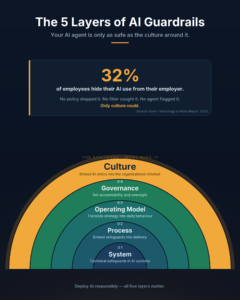
8. Guardrails — Safety Layer
Category: AI Safety & Governance
Guardrails are rules, constraints, and safety boundaries that prevent agents from taking harmful, unauthorized, or out-of-scope actions — even when instructed to do so.
They operate at multiple levels: prompt-level filtering, tool-use restrictions, output validation, and action blocklists.
🔍 Real-World Example: An agent is blocked from deleting production databases even if explicitly instructed to “clean everything up.”
Why it matters technically:
- Non-negotiable for production deployments
- Implemented as input filters, output validators, and action policy engines
- Must be layered (not single-point) — defense in depth is essential
9. Sandboxing — Safe Execution
Category: Security & Infrastructure
Sandboxing provides an isolated execution environment where agents can run code, scripts, or processes without risking damage to the host system or production infrastructure.
It’s the “blast radius containment” strategy for agentic systems.
🔍 Real-World Example: Claude Code runs user scripts inside a Docker container before applying any changes to the actual repository — keeping production safe.
Why it matters technically:
- Essential when agents can write and execute arbitrary code
- Common sandbox technologies: Docker, Firecracker microVMs, WASM
- Sandboxes must balance security with resource access needed for legitimate tasks
10. Human-in-the-Loop — Approval Gate
Category: Design Pattern / Risk Management
Human-in-the-Loop (HITL) is a design pattern where agents pause execution and request human confirmationbefore proceeding with high-stakes, irreversible, or sensitive actions.
It’s the “are you sure?” dialog box — but architected into the agent’s decision logic.
🔍 Real-World Example: An agent drafts a client email and prepares to send it — but waits for your explicit approval before hitting send.
Why it matters technically:
- Balances automation efficiency with human oversight
- Critical for compliance in regulated industries
- HITL touchpoints must be strategically placed — too many creates bottlenecks, too few creates risk
11. Context Window — Working Memory Limit
Category: Model Architecture Constraint
The Context Window is the maximum amount of text an agent can read and reason over in a single interaction — its active working memory. Everything beyond this limit is, effectively, invisible to the model.
🔍 Real-World Example: A 200K token context window lets an agent read an entire large codebase before writing a single line of code — maintaining full project awareness.
Why it matters technically:
- Context window size directly impacts task complexity an agent can handle
- Efficient context management (summarization, pruning, compression) is a critical engineering challenge
- Long-context models (Gemini 1.5, Claude 3.x) are unlocking new agentic use cases
12. Multi-Agent — Collaborative Intelligence
Category: System Architecture Pattern
A Multi-Agent System is an architecture where multiple specialized AI agents collaborate, each handling different tasks in parallel or sequence, to solve problems that are too complex for a single agent.
🔍 Real-World Example: One agent researches a topic, another writes the draft, a third fact-checks the content — all coordinated by an orchestrator running the whole pipeline.
Why it matters technically:
- Enables massive parallelization of cognitive work
- Each agent can be independently optimized for its specialty
- Inter-agent communication protocols, state sharing, and conflict resolution are active areas of research and engineering
How These 12 Terms Fit Together
Here’s how the concepts interconnect in a real-world agentic system:
flowchart TD
    A["User Goal"] --> B["Orchestrator\n(Agent Manager)"]
    B --> C["Agent Loop\n(Perceive Plan Act Observe)"]
    C --> D["Subagent 1\n(Researcher)"]
    C --> E["Subagent 2\n(Writer)"]
    C --> F["Subagent 3\n(Fact-Checker)"]
    D --> G["Tool Use\n(APIs, Browsers, Code)"]
    E --> H["Memory\n(Short and Long Term)"]
    F --> I["Grounding\n(Live Data Sources)"]
    G --> J["Sandboxing\n(Safe Execution)"]
    B --> K["Guardrails\n(Safety Layer)"]
    B --> L["Human-in-the-Loop\n(Approval Gate)"]
    D & E & F --> M["Context Window\n(Working Memory)"]
    M --> N["Final Output"]
    B -.->|"MCP connects everything"| G
Why This Vocabulary Matters
Understanding these 12 terms isn’t just academic — it directly impacts how you:
- Design robust, scalable agentic architectures
- Debug agent failures (is it a memory issue? a grounding failure? a context overflow?)
- Secure deployments with proper guardrails and sandboxing
- Communicate with stakeholders, PMs, and other engineers
- Evaluate AI tools and frameworks intelligently
Final Thoughts
Agentic AI is not a distant future — it’s the present frontier. Systems built on these 12 primitives are already automating research workflows, writing and deploying code, managing customer pipelines, and synthesizing knowledge at scale.
The engineers and architects who internalize this vocabulary today will be the ones building the systems that define tomorrow.
Save this post for reference. Share it with your team. The agentic era is here.