As we transition into a new era where AI agents are no longer just passive assistants but powerful autonomous collaborators, the need for modular, scalable, and interoperable AI systems has never been greater. The “AI Agent System Blueprint” presents a comprehensive and structured architecture that enables the development, orchestration, and integration of intelligent AI agents into complex enterprise workflows.
This blueprint focuses on six core layers:
1. Input/Output (User Interface Layer)
At the top of the blueprint lies the multimodal input/output layer, where users interact with AI agents via:
- Text
- Document
- Image
- Video
- Audio
This layer is designed to support a Chat UI or any multimodal interface, enabling seamless communication between users and AI systems. These interfaces can intelligently process various data types to trigger agent workflows.
2. Orchestration Layer
The Orchestration layer is responsible for building the foundation for agents to operate effectively. It uses a variety of development kits, SDKs, and orchestration tools to control, manage, and optimize the agent behavior. Key components include:
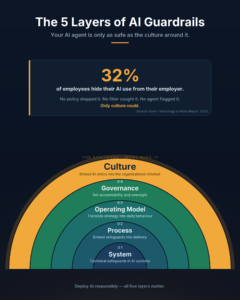
- Guardrails: To enforce safety and policy constraints.
- Tracing: For visibility into agent decision-making processes.
- Streaming: For real-time interaction.
- Evaluation: For continuous testing and performance optimization.
This layer also covers:
- Deployment Support
- Context Management to ensure agents operate with the most relevant data and task context.
3. Reasoning Layer
This is the core intelligence of the AI agent system. It separates agents from rigid automation by enabling dynamic, contextual reasoning. It integrates multiple types of language models:
- LRMs (Lightweight Reasoning Models) — E.g., OpenAI o3, Deepseek R1
- LLMs (Large Language Models) — E.g., Gemini Flash, Claude 3.5 Sonnet
- SLMs (Small Language Models) — E.g., Gemma 3, Pixtral 12b
These models empower agents to make decisions, perform inferences, and orchestrate multi-step workflows.
4. Data and Tools Layer
Agents need context to function effectively. This layer connects the system to enterprise data and external tools, enabling context-aware actions. It includes:
- MCP Server (Modal Context Protocol): Acts as a broker to fetch contextual data from various sources.
- Vector DBs and Semantic DBs: Provide memory and embedding search capabilities.
- Third-party API Integrations: Such as Stripe (payments), Brave (search), Slack (collaboration).
This allows dynamic enrichment of agent capabilities via MCP protocol—ensuring agents are always updated with the most relevant information.
5. Agent Interoperability Layer
Single-agent architectures are limited in scope. This layer unlocks multi-agent orchestration through the A2A Protocol (Agent-to-Agent). It enables:
- Cross-agent communication
- Multi-agent task sharing
- Collaborative workflows
Example:
- A Sales Agent can trigger a Documentation Agent to generate proposals after a client interaction.
- A Controller Agent oversees coordination across multiple agents.
This layer is crucial for scaling AI use cases across domains and departments.
6. Protocols: MCP and A2A
These are the communication backbones:
- MCP (Modal Context Protocol): Connects orchestration and reasoning with dynamic data sources.
- A2A (Agent-to-Agent Protocol): Enables multi-agent workflow interoperability and composability.
Why This Blueprint Matters
This modular architecture offers:
- Scalability: Easily scale from one agent to many.
- Extensibility: Add new tools or models without rewriting core logic.
- Security and Governance: With guardrails and observability built-in.
- Multi-Modality: Supports the full spectrum of user interactions.
Conclusion
The AI Agent System Blueprint provides a solid foundation for building intelligent, scalable, and enterprise-ready AI agents. By leveraging modular components like orchestration, context management, reasoning engines, and inter-agent protocols, organizations can transform passive AI assistants into proactive, goal-driven digital collaborators.
This framework can accelerate your journey toward autonomous enterprise automation while maintaining flexibility, control, and security.